
Clinical, Regulatory, and Medical Affairs
What are Clinical, Regulatory, and Medical Affairs roles?
Clinical, Regulatory, and Medical Affairs professionals help ensure that healthcare products and technologies are developed, evaluated, approved, and used responsibly. These functions serve as a bridge between scientific research, regulatory requirements, healthcare practice, and patient needs, supporting the journey of products from development through real-world use. While their responsibilities vary, they share a common goal of ensuring that products are supported by robust evidence, meet regulatory standards, and provide meaningful benefits to patients and healthcare systems.
For individuals with research and healthcare backgrounds, clinical, regulatory, and medical affairs careers offer opportunities to leverage scientific expertise while contributing to the development, approval, and responsible use of products that improve patient care and health outcomes.
Explore Clinical, Regulatory, and Medical Affairs Roles
Discover what it means to work in clinical, regulatory, and medical affairs and the common job qualifications!
Medical Science Liaison (MSL)
Medical Science Liaisons (MSLs) serve as scientific experts who connect healthcare professionals, researchers, and industry organizations. Their primary role is to facilitate the exchange of scientific and clinical information, helping ensure that healthcare stakeholders have an accurate understanding of the evidence supporting products, therapies, and emerging areas of research.
MSLs work across a variety of sectors, including pharmaceuticals, biotechnology, medical devices, diagnostics, and digital health. They engage with physicians, researchers, pharmacists, and other healthcare professionals to discuss scientific data, clinical research findings, treatment landscapes, and emerging healthcare needs. Through these interactions, MSLs help organizations better understand the perspectives and experiences of the healthcare community while supporting evidence-based decision-making.
A significant component of the role involves communicating complex scientific information in a clear, balanced, and accessible manner. MSLs often discuss clinical trial results, explain scientific publications, respond to medical and research-related questions, and provide insights into evolving areas of medicine and healthcare. They may also support scientific meetings, educational programs, advisory boards, and collaborative research initiatives.
MSLs act as an important bridge between external stakeholders and internal teams. They frequently collaborate with colleagues in Medical Affairs, Clinical Development, Regulatory Affairs, Research and Development, and Commercial functions to share scientific insights gathered from the field and help inform organizational strategies. Their work contributes to understanding unmet patient needs, emerging evidence, and opportunities for future research.
For individuals with graduate or postdoctoral training, the MSL role offers an opportunity to remain closely connected to science and medicine while working in a highly collaborative and communication-focused environment. Many of the skills developed through research training, including critical evaluation of evidence, scientific communication, relationship building, and knowledge translation, are highly valued in this career path.
- MSL positions typically require an advanced degree such as a PhD, PharmD, MD, in a health, biomedical, or scientific discipline.
- Advanced scientific or medical knowledge in a relevant therapeutic area
- Experience critically evaluating and interpreting scientific literature
- Strong verbal and written communication skills
- Experience presenting scientific information to diverse audiences
- Demonstrated ability to build professional relationships and collaborate effectively with stakeholders
- Scientific expertise – Deep understanding of scientific and clinical evidence and the ability to discuss complex topics accurately and credibly
- Scientific communication – Ability to explain technical information clearly to audiences with different levels of scientific knowledge
- Relationship building – Capacity to develop and maintain professional relationships with healthcare professionals, researchers, and other stakeholders
- Knowledge translation – Skill in translating research findings into practical insights that support understanding and decision-making
- Presentation skills – Ability to deliver engaging and informative scientific presentations in various settings
- Active listening – Capacity to understand stakeholder perspectives, identify emerging needs, and gather meaningful insights from discussions
- Collaboration – Experience working effectively across multidisciplinary teams to support shared objectives
- Critical thinking – Ability to evaluate evidence, assess scientific questions, and communicate balanced interpretations of data
- Stakeholder engagement – Skill in interacting professionally with external experts and representing an organization in scientific discussions
- Adaptability – Ability to stay current with evolving scientific evidence, therapeutic advancements, and healthcare trends
Clinical Scientist
Clinical Scientists play a key role in the generation and interpretation of evidence that supports the development and evaluation of healthcare products and technologies. They work at the intersection of science, medicine, and clinical research, helping organizations understand how products perform in real-world and research settings and informing decisions throughout the product lifecycle.
Their work involves designing clinical research studies, analyzing and interpreting clinical data, evaluating scientific literature, and contributing to the development of evidence that demonstrates the safety, effectiveness, and value of products. Depending on the organization, Clinical Scientists may support clinical trials, observational studies, evidence generation initiatives, or broader research programs.
Clinical Scientists work closely with multidisciplinary teams that may include clinical operations professionals, physicians, medical affairs specialists, regulatory experts, data scientists, statisticians, and product development teams. They provide scientific and clinical expertise throughout research projects, helping to ensure that studies are appropriately designed, data are interpreted accurately, and findings can inform decision-making.
A significant aspect of the role involves translating complex scientific and clinical information into meaningful insights for diverse audiences. This may include preparing study reports, contributing to scientific publications, presenting findings, and communicating evidence to internal stakeholders and external partners.
Clinical Scientists must balance scientific rigor with practical considerations such as study feasibility, patient needs, regulatory expectations, timelines, and organizational objectives. Their work supports evidence-based decision-making and contributes to the responsible development and use of healthcare products and technologies.
For individuals with graduate or postdoctoral research experience, this role provides an opportunity to apply expertise in study design, data analysis, critical appraisal, and scientific communication while remaining closely connected to advances in healthcare and clinical research.
- Clinical Scientist positions often require a PhD, PharmD, MD, or other advanced degree in a health, biomedical, scientific, or related field.
- Experience designing, conducting, or supporting clinical or health-related research
- Strong understanding of scientific and clinical research methods
- Experience analyzing and interpreting complex data
- Demonstrated ability to communicate scientific findings to diverse audiences
- Familiarity with clinical research, healthcare, or regulated environments is often considered an asset
- Clinical research knowledge – Understanding of study design, research methodologies, and evidence-generation approaches used in healthcare and clinical settings
- Data analysis – Ability to interpret complex datasets, evaluate findings, and draw evidence-based conclusions
- Critical thinking – Capacity to assess scientific evidence, identify limitations, and evaluate the implications of research findings
- Scientific communication – Ability to communicate complex clinical and scientific information clearly through reports, presentations, and publications
- Attention to detail – Ability to ensure accuracy, consistency, and quality in research activities and scientific documentation
- Collaboration – Experience working effectively with multidisciplinary teams across scientific, clinical, regulatory, and operational functions
- Project management – Skills in coordinating activities, managing timelines, and contributing to the achievement of project goals
- Problem-solving – Ability to address research challenges, evaluate options, and develop practical solutions
- Stakeholder engagement – Ability to work with internal and external partners, including researchers, healthcare professionals, and industry colleagues
- Adaptability – Capacity to navigate evolving scientific evidence, changing priorities, and dynamic healthcare environments
Resources to help you land a clinical, regulatory, or medical affairs role
Access essential resources to support you at every stage of your journey toward securing a clinical, regulatory, or medical affairs role!
Agilis Health’s MSL Accelerator Academy is a two-day training, designed for aspiring and current Medical Science Liaisons (MSLs) looking to sharpen their expertise, enhance their strategic thinking, and elevate their ability to generate impactful medical insights.
A University of Toronto student initiative created to bridge the gap between academia and industry. LSCDS hosts networking events, mentorship programs, industry team case studies, career seminar series, and more.
BioTalent Canada provides technical skills training designed for the Canadian bio-economy, including programs on the fundamentals of scientific report writing, good laboratory practice (GLP), good manufacturing practice (GMP), quality assurance/quality control (QA/QC), and good clinical practice (GCP).
An immersive talent development program aimed at producing industry-ready, highly qualified personnel through comprehensive training initiatives with deep industry engagement.
A series of videos covering career development topics, including how to convert your CV to a resume, questions to ask when networking, job searching tips, how to use LinkedIn, networking tips for introverts, how to prepare for interviews, and more.
The Effective Mentorship Training Program is an annual program offered by the UHN Office of Research Trainees for UHN graduate students and postdoctoral researchers who will be supervising summer students. The program covers topics such as effective communication, aligning expectations, assessing understanding, establishing inclusive practices, fostering independence, and promoting professional development.
Skillsoft Percipio Learning Platform is a free virtual learning platform for TeamUHN that offers self‑paced courses and live classes to help build skills in leadership, business, communication, and more. The platform also includes training and educational content that can be applied toward the Project Management Institute’s requirements for the Project Management Professional (PMP) certification!
Meet UHN Alumni
Meet UHN alumni who have gone on to build impactful and influental careers in clinical, regulatory, or medical affairs!
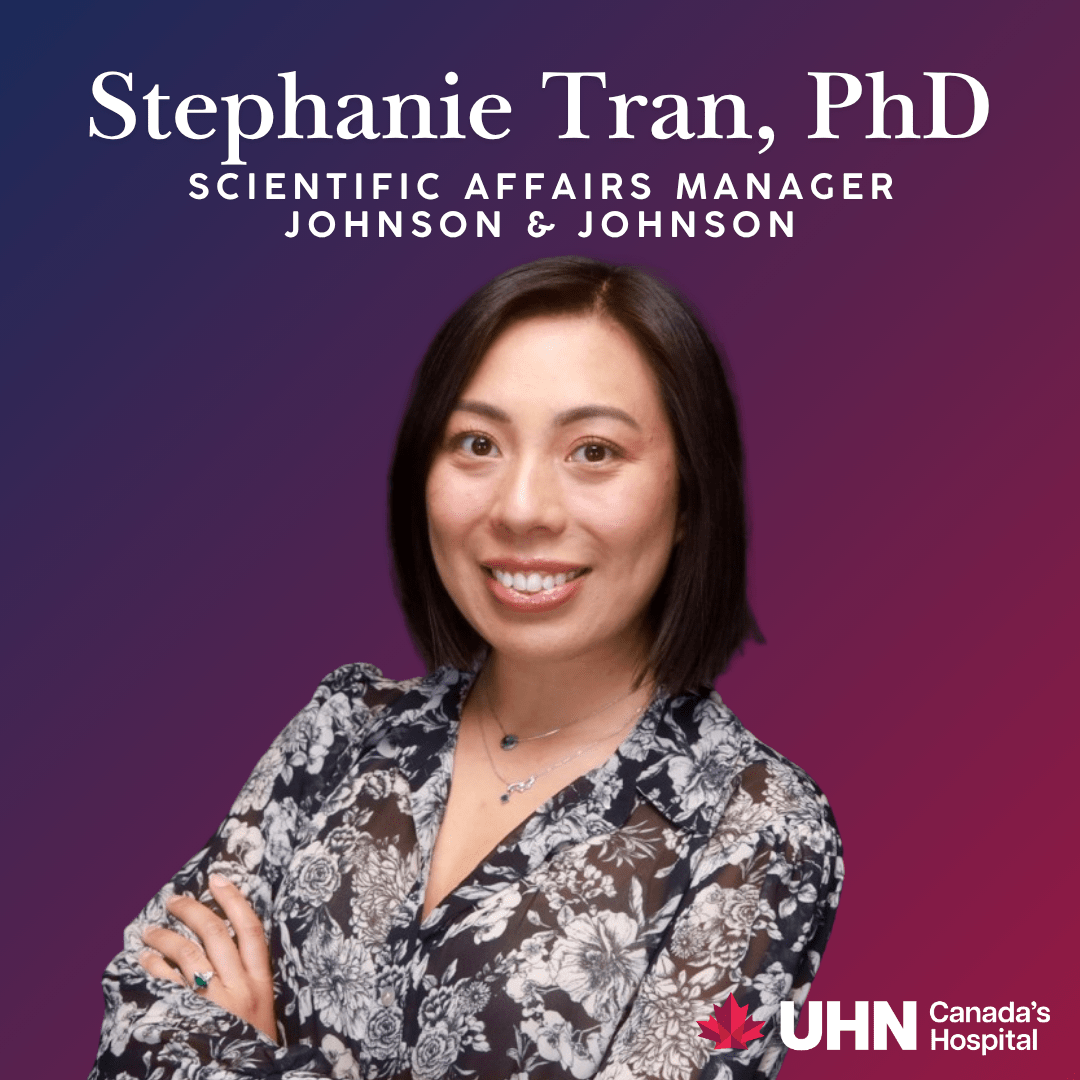
Dr. Stephanie Tran is a Scientific Affairs Manager at Johnson & Johnson. Dr. Tran is also a former PhD student at the Krembil Research Institute, UHN.
Don’t limit yourself to exploring one job title or role. Talk to many people, network, and figure out what sparks your interest.
To lean more about Dr. Tran and her journey towards becoming a Scientific Affairs Manager, you can read our alumni spotlight, written by Crizza Ching, ORT Communications Assistant and Graduate Student.
Disclosure: This resource is provided for informational purposes only. All efforts have been made to ensure the accuracy and clarity of the content; however, specific details, requirements, and expectations may vary across institutions and positions. Readers should always consult individual job postings or official organizational resources for the most current and authoritative information.